



'Keeping Ourselves Safe' PSHE/RSHE
Friends pick us up when we fall down, and if they can't pick us up ... they lie down and listen for a while.
Disney Pixar - 'Inside Out'
Our Curriculum
Our 'proactive' PSHE/RSHE curriculum is supplied though Coram Life Education and their 'SCARF' scheme of work and then adapted and Made for Manor as part of our pedological approach to quality first teaching and learning. This is then enhanced though our wider personal development enrichment map offer as well as supplemented with 'reactive' lessons on topics of themes to ensure that we are 'Keeping Safe' in our skills, knowledge and understand of 'at-risk themes' which present throughout the year.
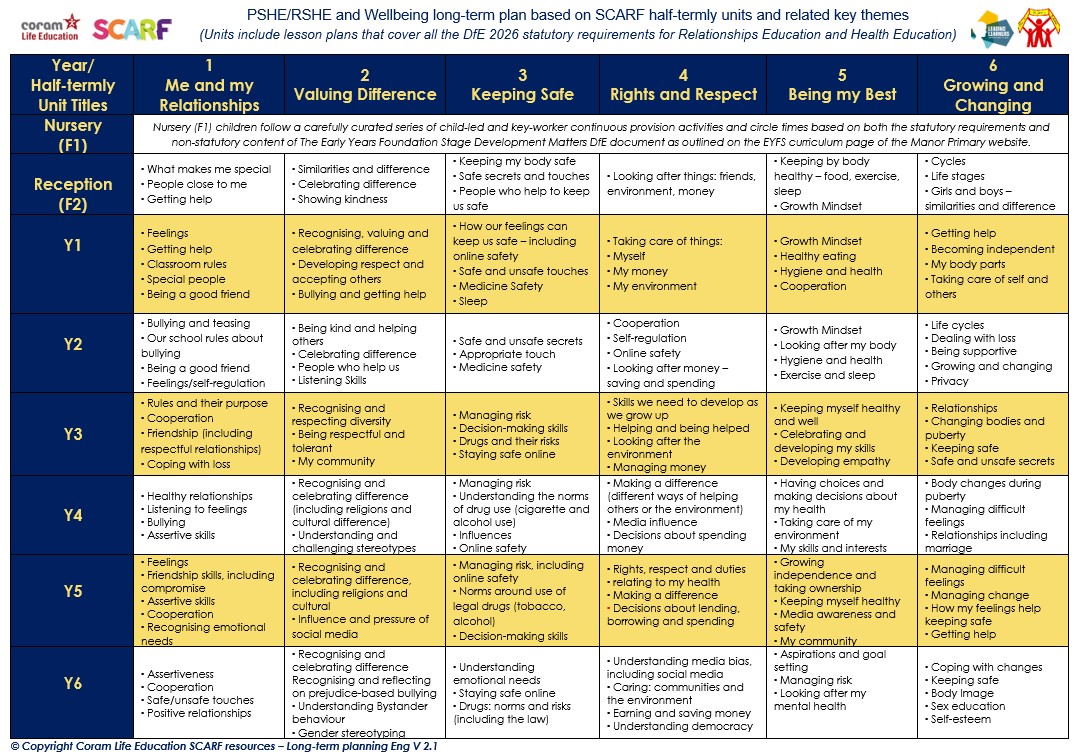
'Keeping Ourselves Safe' PSHE/RSHE - Long Term Plan
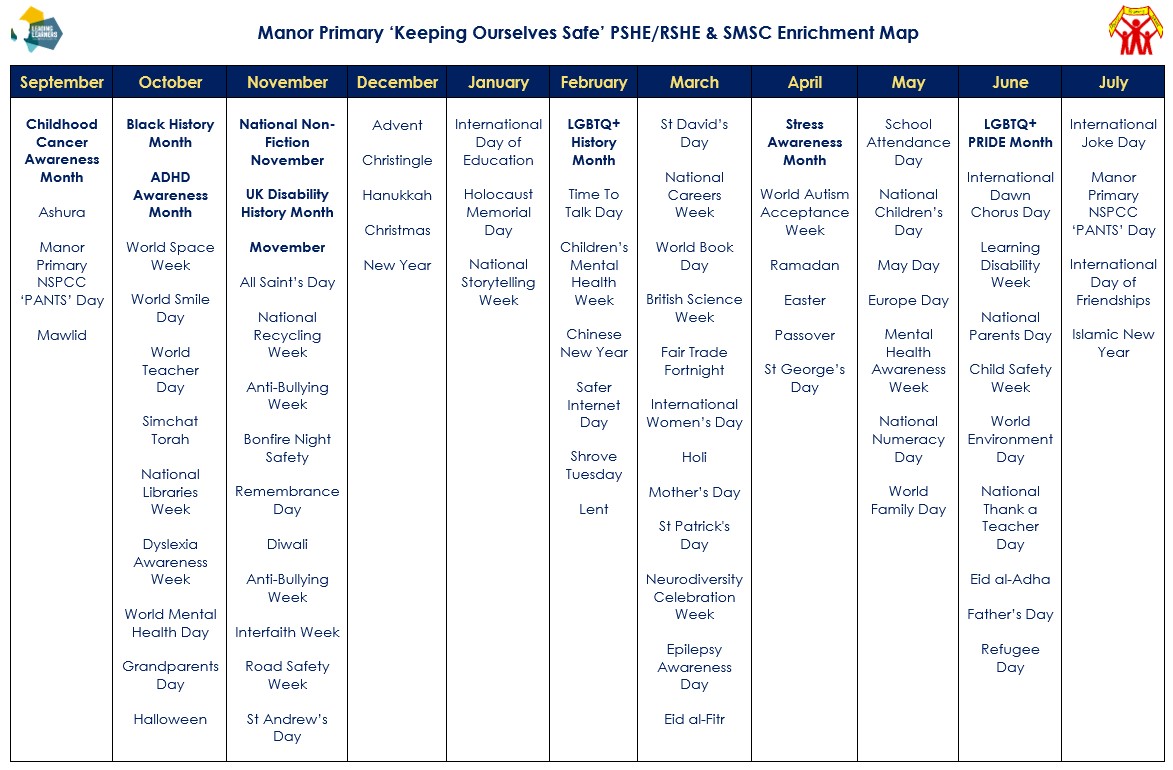
'Keeping Ourselves Safe' PSHE/RSHE & SMSC - Enrichment Map
Intent
Our PSHE ‘Life-Skills’ education, including statutory Relationships and Health education, and non-statutory sex education, as recommended by the DfE, provides a framework though which key skills, attributes and knowledge can be developed and applied. This promotes positive behaviour, good mental health and wellbeing, resilience and achievement, helping children to stay safe online, develop healthy and safe relationships, making sense of media messages, challenging extreme views and having the skills and attributes to negotiate and assert themselves now and in the future.
Our PSHE/RSHE ‘Life-Skills’ curriculum, and wider Personal Development (PD) offer, supports the school’s intent of developing resilient, confident citizens and successful learners who are creative, resourceful and able to identify and solve problems positively. The social, moral and emotional development of our pupils is embedded throughout the entire school curriculum and culture, structured on a foundation of British Values and an embedded knowledge of the Protected Characteristics. Our school has a robust combination of a planned thematic PSHE/RSHE program, built around a spiral curriculum of recurring themes, designed to:
- Give pupils the knowledge and develop the self-esteem, confidence and self-awareness to make safe informed choices and decisions able to manage life’s challenges both in the online and offline world;
- Encourage and support the development of social skills and social awareness;
- Enable pupils to make sense of their own personal and social experiences;
- Promote responsible attitudes towards the maintenance of good physical and mental health, supported by a safe and healthy lifestyle;
- Enable effective interpersonal relationships and develop a supportive, considerate and caring attitude towards others;
- Encourage a caring attitude towards and responsibility for the environment;
- Help our pupils understand and manage their feelings, build resilience and be independent, curious problem solvers;
- Understand how society works and the laws, rights and responsibilities involved.
We know there is a proven link between pupils' health and wellbeing, and their academic progress. Crucial skills and positive attitudes developed through comprehensive PSHE/RSHE are critical to ensuring children are effective learners thereby promotional the best life-chances for all our pupils, and wider school community, no matter of individual circumstances.
Implementation
We will achieve our PSHE/RSHE ‘Life-Skills’ intention though focused, once a week, timetabled, creative exploration and discussion-based lessons, which are enriched discreetly across the school day and in every aspect of our school culture, to maximise pupil's opportunities to understand and respect who they are, whilst embracing, and defending, the diverse society in which they live. PSHE/RSHE ‘Life-Skills’ lessons are taught by their class teacher, throughout the whole year in their usual classes, in mixed sex groupings, using a range of interactive teaching methods, e.g. activity sheets, films, songs, online games, and drama techniques. In our mixed year groups children follow a two-year teaching cycle to ensure that all statutory content is taught however, for the delivery of RSHE content for ‘Growth and Changing’, mixed year groups are separated to ensure that pupils are not exposed to learning content beyond their age or level of maturity.
At Manor Primary we use ‘SCARF’, a comprehensive spiral scheme of work for PSHE/RSE and Wellbeing education, to provide our PSHE/RSHE ‘Life-Skills’ curriculum. An overview of SCARF can be found by visiting https://www.coramlifeeducation.org.uk/what-we-do. SCARF (provided by Coram Life Education) covers all of the DfE's statutory requirements for Relationships Education and Health Education, including non-statutory Sex Education, and the PSHE Association’s Programme of Study’s recommended learning opportunities, as well as contributing to different subject areas in the National Curriculum. SCARF has a strong emphasis on age-appropriate emotional literacy, building resilience and nurturing mental and physical health within a whole-school approach. This programme is designed to sensitively match the needs of our pupils yet provides the flexibility of delivery to ensure educational responsibility and professional discretion safeguarding pupils towards teaching that preventative and timely rather than strictly age-related.
We follow the six suggested half termly units as our ‘proactive curriculum’ We then supplement or adapt the scheme of work ‘reactively’ where necessary to meet any ‘individual risk factors’ which our pupils may be challenged with, or to support the local circumstances and the ‘community risk factors’ of our school. Pupil voice is also considered and fed into the planned programme. This bespoke offer ensures that the adopted curriculum is ‘Made for Manor’ and both targeted and relevant to the ever-changing needs of our pupils.
Our PSHE/RSHE subject lead, Mr Croft, works in close conjunction with teaching staff in each year group, including the SEMH Resource Provision, and is responsible for ensuring that all staff are equipped with the knowledge, skills and resources to deliver PSHE/RSHE ‘Life-Skills’ education confidently. Teachers have access to a range of teaching support resources, provided via the Coram Education website, including guidance documents and teacher CPD training films. Any teacher wanting further support should contact the PSHE subject lead in the first instance to discuss their training needs. The lesson plans list the specific learning objectives for each lesson and provide support for how to teach the lessons. Opportunities are then also provided for class teachers to meet with our PSHE lead to discuss learning objectives, support needs or additional training requirements on an informal basis.
At Manor Primary we have chosen ‘SCARF’ as our PSHE-RSHE ‘Life Skills’ resource because the lessons build upon children’s prior learning. We have consulted towards and assessed the content offer and feel that it is relevant and sensitive to the needs of the children. There is planned progression across the SCARF scheme of work, so that children are increasingly and appropriately challenged as they move up through the school. For primary education the DFE has set out statutory expectations for progress assessment in PSHE-RSHE allowing schools significant flexibility in how progress is measured however, assessment must have the “same high expectations of the quality of pupil's work”. Assessment is therefore completed by the class teacher using the following ‘SCARF’ mechanisms;
- SCARF Progress: Pre and post unit assessments: This eenables teachers and the children to see the progress that has been made over the course of each half-termly unit of planned lessons. For each unit there is a specially designed pre-and-post unit assessment activity. Conducted twice, this first determines the baseline; it's then repeated at the end of the unit, enabling you to monitor progress, record key points and identify areas for further development. Staff monitor the content of these assessment and adapt them according to the needs and requirements of their cohorts.
- SCARF Success: 'I can...' statements: Teachers use a ‘strong-fit’ methodology towards the SCARF provided summative assessment ‘I can…' statements, alongside the lesson plan learning outcomes to demonstrate progression of both skills and knowledge as a summarizing tool of learning against each unit's key learning outcomes.
The results of assessments are analysed by teachers to inform their teaching practice and curriculum content choices as well as shared with the PSHE-RSHE lead for whole school scrutiny.
These methods of assessment also enable the teacher to make an annual assessment of progress for each child, as part of the child’s annual report to parents. We pass this information on to the next teacher at the end of each year as part of our transitions process.
The Early Years Foundation Stage
In the Early Years Foundation Stage, PSHE-RSHE is represented as Personal, Social and Emotional Development (PSED) which is one of the Prime Areas of Development Matters. PSED in a child’s learning journey is about making connections; it’s strongly linked to child-led activities, including play. PSED is taught through activities that are part of topics, as well as on an individual basis to develop personal skills such as dressing, feeding and toileting. Positive experiences are built through daily opportunities, to share and enjoy a range of different activities. F1 children are given the opportunity to engage in play-based child-led and key-worker guided social activities as part of the Universal Continuous Prevision offer as well as small group Key-Worker led circle times. F2 children benefit from the same provisioning as F1 however, they also take part in a weekly whole-class teacher-led session exploring being safe indoors and outdoors in their ‘Life-Skills’ SCARF lesson via the 6 themed units followed by KS1 and KS2 as a progressive curriculum from EYFS to Y6. These lessons are time restricted and build in expectation throughout the F2 year.
KS1 and KS2
Our SCARF programme divides the year into 6 themed units taught in an order timetabled ‘proactively’ and ‘reactively’ though identifying the pupil and community needs and ‘at-risk factors’ and revised for each academic year:
- Me and My Relationships: includes content on feelings, emotions, conflict resolution and friendships;
- Valuing Difference: a focus on respectful relationships and British values;
- Keeping Myself Safe: looking at keeping ourselves healthy and safe
- Rights and Responsibilities: learning about money, living the wider world and the environment;
- Being My Best: developing skills in keeping healthy, developing a growth mindset (resilience), goal-setting and achievement;
- Growing and Changing: finding out about the human body, the changes that take place from birth to old age and being safe.
Children are encouraged to engage in activities that promote an understanding of themselves as growing and changing individuals, and as members of a wider community, based on their own first-hand experiences. These activities also encourage pupils to understand how their choices and behaviours can affect others. They are encouraged to play and learn alongside – then collaboratively with – their peers. They may use their personal and social skills to develop or extend these activities. Children are also given the opportunity to make choices about their health and environment and are encouraged to develop a caring attitude towards others.
Within National Curriculum Science in Y2, the children learn that animals, including humans, have offspring that grow into adults. They should be introduced to the concepts of reproduction and growth, but not how reproduction occurs. In Y5, children are taught about the life cycles of humans and animals, including reproduction. They also learn about the changes that happen in humans from birth to old age. This includes learning what happens in puberty.
It is important that the transition phase before moving to secondary school supports pupils’ ongoing emotional and physical development effectively. The DfE recommends that all primary schools should have a sex education programme, tailored to the age and the physical and emotional maturity of the pupils. Within our non-statutory sex education that takes place, lessons around sex as ‘reproduction’ take place in Y5 and Y6. Children in Upper Key Stage 2 will learn about how a baby is conceived, whether through sexual intercourse or IVF. This information builds on content they have previously learnt in the programme about relationships, puberty changes and reproduction; it lays the foundations for their ongoing Relationships and Sex Education in their secondary phase. Non-statutory sex education is about the emotional, social and cultural development of pupils, and involves learning about relationships, sexual health, sexuality, healthy lifestyles, diversity and personal identity. RSHE is not about the promotion of sexual activity.
To ensure that children feel comfortable to learn about a range of topics, we create a safe learning environment using a group agreement at the beginning of lessons or topics. This includes a confidentiality statement understood by adults and children. The teachers will also use a range of skills, including distancing techniques and the anonymous question box. Teachers will answer children’s questions factually and honestly in an age-appropriate way and respond to any disclosures following the schools safeguarding procedures / child protection policy which can be found on the school website https://www.manorprimaryschool.co.uk/Keeping-Our-Children-Safe/. Support is provided to children experiencing difficulties on a one-to-one basis, via our safeguarding team and, where necessary or appropriate, outdoor agencies are involved with the support of parent and careers within the remits of our school policies.
It is not our school’s policy to withdraw pupils with special educational needs, or who have vulnerable status, from PSHE-RSHE ‘Life Skills’ education to catch up on other national curriculum subjects: these aspects of personal and social development are as important to all pupils as their academic achievement, and contribute to it. Lesson plan content will be adapted and extra support provided where necessary to ensure all pupils are enabled to develop key skills, attributes and knowledge developed through the PSHE-RSHE ‘Life Skills’ education programme. Work in PSHE-RSHE ‘Life Skills’ takes into account the targets set for individual children in their Individual Education Plans (IEPs).
SCARF lesson plans are flexible and allow for teachers, who are skilled in adapting curriculum content to meet the needs of the children in their class, to adjust their content in order to meet the learning outcomes.
Our school ensures that the Relationships Sex and Health Education (RSHE) elements of the PSHE education programme are relevant to all pupils. All pupils learn together about all the changes that someone may experience as they go through puberty to help develop empathy and understanding and to reduce incidences of teasing or stigma. This will also ensure any child that identifies as transgender or is gender questioning, will have access to RSHE that is relevant to the puberty they are likely to experience.
Our school acknowledges different ethnic, religious and cultural attitudes, as well as recognising that pupils may come from a variety of family situations and home backgrounds. These different families are acknowledged through our teaching and the use of resources that promote diversity and inclusion in Relationships Education.
Research shows that, on average, about 10% of pupils will go on to define themselves as gay, lesbian, or bi-sexual. It is possible that some pupils will also have LGBT parents / carers, brothers or sisters, other family members and / or friends. Our PSHE-RSHE ‘Life Skills’ education acknowledges this through scenarios, in a sensitive, honest and balanced consideration of sexuality. This helps create a safe environment for all pupils and staff. The public sector equality duty, created under the Equality Act, requires schools and other public authorities to eliminate discrimination and to advance equality in its everyday business, in the design of its policies and curriculum. Schools have a legal responsibility for eliminating discrimination; to do this, schools are required to raise pupils’ awareness of diversity and promote respectful relationships with those who are different from them.
For further information please visit our school website for policies on anti-bullying, equality, diversity and inclusion https://www.manorprimaryschool.co.uk/Policies/
What you will see in a Manor Primary School PSHE/RSHE ‘Life Skills’ Lesson
- An adapted ‘proactive’ and ‘reactive’ curriculum offer which is ‘Made for Manor’ in this ethos.
- Lessons are relevant to the children, their life, the wider world and the modern risks they are exposed to, including digital, in the context of our local area and wider community pressures.
- Teaching covers the breath of PSHE/RSHE, including the statutory changes to Relationships, Sex and Health Education (2026).
- Children’s prior learning and growing understanding is revisited and reinforced using their class Personal Development floor book and G-Drive e-floor book.
- High-quality questioning to assess children’s prior knowledge, during and throughout each themed unit.
- Lessons are well-structured, engaging and stimulating.
- An emphasis on correct and ambitious vocabulary.
- High-quality verbal feedback is provided throughout lessons – in line with the Year group overviews.
- It is expected that during PSHE/RSE ‘life-skill’ lessons, an emphasis will be placed on active learning through planned discussions, circle-time, investigations, stories, role-play activities, puppets, group-work and problem-solving.
- Sequenced lessons which deepen understanding and are meaningful in their delivery and impact.
- Evidence of cross-curriculum links, engagements and enrichment activities.
- Achievement and Inclusion for all: All activities are planned, scaffolded and adapted where needed to ensure every child at Manor Primary School can achieve highly in PSED/PSHE/RSE. This may include adapted resources, adult support and awareness of emotional, wellbeing, physical and sensory needs.
Impact
The impact of our PSHE-RSHE ‘Life Skills’ whole school approach will foster pupils who are able to make safe, responsible and healthy choices as they become confident citizens;
- Who are confident, resilient and independent.
- Wo are reflective, behave with integrity and cooperate consistently well with others.
- Who will demonstrate and apply the British Values of Democracy, Tolerance, Mutual Respect, Rule of Law and Liberty.
- Who will demonstrate resilience and a positive mental attitude to their work.
- Who can understand how to keep themselves safe at home and at school, both online and offline, and know who can support and help them.
- Who can use digital devices safely and understand how to report unacceptable behaviour.
- Who can understand the different lifestyles that others may have and are able to be respectful and tolerant towards others who may live differently to themselves.
- Who can demonstrate their understanding and support their views with reasoning.
- Who can maintain positive relationships with a diverse range of family and friendship groups.
- Who understand their protected characteristics at a developmentally appropriate level.
- Who are very well prepared for life beyond school.
- Who, though high attendance and levels of progression, demonstrate an aspiration to achieve in line with national expectations as barriers are removed for children to become successful.
MEASURING IMPACT
At Manor we celebrate the creative, expressive, nontangible elements of such a broad and all-encompassing subject therefore we will measure PSHE impact through:
- Monitoring of the ‘proactive’ curriculum and its successful delivery and implementation.
- Monitoring the ‘reactive’ adaptions to the curriculum which better reflect the needs and risks of our community in the context of our school location and general demographic.
- Monitoring and celebration of dynamic and creative class ‘Personal Development Floor Books' as an expression of pupil's engagement, achievement, thoughts and understanding of subjects, themes and topics explored.
- PSHE Subject Lead & SLT learning walks and ‘evidence looks'.
- Pupil voice as an expression and celebration of intent, implementation and impact to include in depth understanding of personal safety, positive mental health, wider health education, online safety and themes surrounding VAEG and misogyny.
- Data based ‘teacher judgments’ demonstrating cohort achievement and progression.
Parent RSHE Consultation
//www.youtube.com/embed/0c4xb_e1-rs#t=0.5
year group learning journeys growing and changing rshe.pdf
information for parents and carers about dfe pshe rshe.pdf
Headteacher Assemblies
Weekly personal development assemblies are led by the Headteacher, or senior SLT when required, enhancing children's Keeping Ourselves Safe - PSHE/RSHE lessons by exploring themes that focus on;
- British Values - democracy, the rule of law, individual liberty, and mutual respect and tolerance.
- Protected Characteristics - the defending of civil liberties and rights free from discrimination against a person’s age, disability, gender reassignment, marriage or civil partnership, pregnancy or maternity, race, religion or belief, 'sex' (gender markers), or sexual orientation.
- Celebrating Being Unique - empowering our children to recognise the diversities across our British society, understanding that diversity is our uniqueness and it needs to be protected and celebrated.
- Current Affairs - making relevant, myth-busting and discussing, in an age-appropriate way, events happening in our community, region, country and our wider world to understand it's relevance, impact and significance to 'ourselves', 'our families' and 'our community'.
- Events to Remember - taking time to mark the passing of a school year exploring, remembering and celebrating events which are important to our children and our community.
- Whole School Themes - moments to pause to support children's personal development as they grow on their personal journeys towards become responsible citizens.
Following these assemblies, children then explore the themes and discussion points back in their classroom with their teacher to dive deeply into the learning opportunities to embed their growing knowledge and understanding.
Statutory Documents
pshe rshe manor policy march 2026.pdf
scarf growing and changing glossary.pdf
DfE Website - Relationships and Sex Education (RSE) and Health Education
DfE - Early Years Foundation Stage - PSED Development
Definitions:
Department of Education - Statutory Guidance 2020
We define Sex Education as “… lifelong learning about physical, moral and emotional development.” It involves acquiring information, developing skills, and forming positive beliefs, values and attitudes."
We define Health Education as "….teaching pupils about physical health and mental wellbeing to give them the information that they need to make good decisions about their own health and wellbeing now and in the future."
We define Relationship Education as "… teaching the fundamental building blocks and characteristics of positive relationships, with particular reference to friendships, family relationships, and relationships with other children and with adults and showing respect for others."